


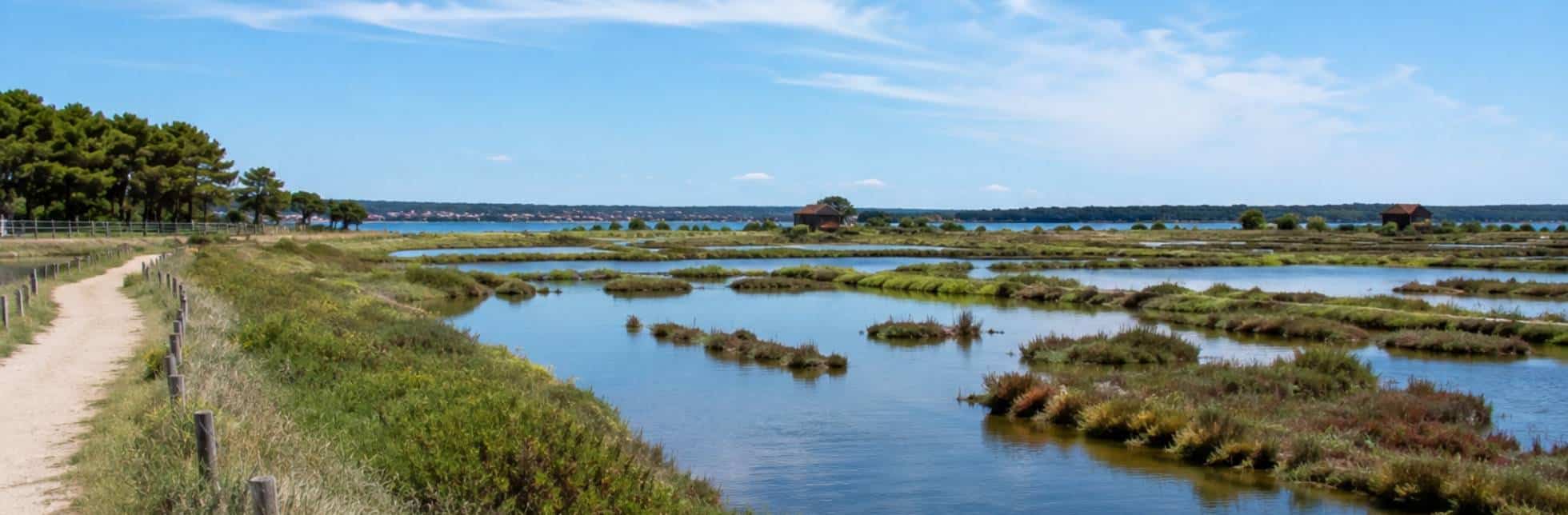
The salt meadows of Arès-Lège formone of the last large expanses of salt marshes in the Bay of Arcachon. Classified as a national nature reserve since 1983, this 496-hectare area stretches between Arès and Lège-Cap-Ferret, following the rhythm of the tides. There’s a 9 km signposted trail, accessible on foot all year round, which crosses mudflats, dune hems and wooded dunes.
The team at our Campsite on the Bassin d’Arcachon shares their tips for preparing your visit, choosing the best period and observing the local wildlife!
Key points to remember
- The national nature reserve covers 496 hectares since its creation in 1983.
- A 9 km-long signposted trail crosses the marshes and is freely accessible all year round.
- The site is home to almost 200 bird species and 7 protected plants.
- There are two entrances to the reserve: the Port d’Arès and the Cabane du Résinier.
- Bikes and dogs are prohibited to preserve the peace and quiet of the species.
Where are the Arès-Lège salt meadows located?
The Arès-Lège salt meadows stretch along the northern tip of the Bay of Arcachon, straddling the communes of Arès and Lège-Cap-Ferret, in Gironde. This protected wetland occupies a unique position between the ocean, the Landes forest and the inland lake.
There are two main entrances to the reserve: the Arès oyster port to the north, and the Cabane du Résinier on the D106 on the Lège-Cap-Ferret side. From our Campsite, you can reach the site in around fifteen minutes, very easily via the coastal road, ideal for a half-day nature outing during your stay.
A national nature reserve between mudflats and wooded dunes
The Salt Meadows National Nature Reserve was created by decree in 1983 and covers 496 hectares. It protects the Bay of Arcachon’s only continuous transition between sea, mudflats, salt meadows and wooded dune.
This mosaic of environments explains the biological richness of the site, which you’ll come across all along the trail.
The basin’s flagship wildlife
The site is home to almost 200 species of birds: brant, herons, egrets and waders in winter, nesting passerines in spring. You’ll also come across the European otter and the Cistude tortoise, and 11 species of fish that use the salt meadows as nurseries.
Protected flora shaped by the tides
More than 250 plant species have adapted to the salt and the regular immersion of the tides. According to Lège-Cap Ferret town council, 7 plants have been granted regional protection, including Romulée bulbocodium, Ruppie maritime and Troscart de Barrelier. In spring, the flowering season punctuates the path with touches of mauve and yellow.
How do you get around salt meadows?
For a stroll through the salt meadows of Arès-Lège, follow the 9 km signposted loop trail, accessible all year round. Start from the oyster port in Arès, or the Cabane du Résinier in Lège-Cap-Ferret. Allow around 2 hours on foot on flat ground.
A few rules apply to ensure the peace and quiet of the site:
- Dogs are not allowed on the course, even on a leash.
- Cycling is not tolerated: the tour is on foot only.
- Bivouacs, fires and gathering are strictly forbidden.
- Keep to the marked trails to preserve fragile habitats.
Our tip: take out your binoculars two hours before high tide, in March or October. The low-angled light of the basin lights up the mudflats, and Brant geese come as close as possible to the path, unafraid of walkers. This is the ideal time to photograph the reserve from the pontoon of the Arès oyster port, without disturbing the colonies.
When to visit and practical advice
The ideal time to visit the Arès-Lège salt meadows is from March to October, when the light is soft and the species abundant. Each season brings its own atmosphere: migratory passage and flowering in spring, shady paths in summer, wintering waterfowl between November and February.
Check the tide tables before you set off: at low tide, the mudflats are exposed and offer the best sightings of shorebirds. At high tide, the channels fill up and the walk takes on a Mediterranean air. Pack your binoculars, water, hat and closed shoes, as the trail remains damp in places.
Do you dream of combining seaside idleness with walks in a protected reserve? Book your stay at Campsite Fontaine Vieille, just a few minutes from the salt meadows of Arès-Lège, and take advantage of our advice to prepare your next outing on the basin.
FAQ – The salt meadows of Arès-Lège
How long does the walk to the Arès-Lège salt meadows last?
The walk to the salt meadows of Arès-Lège lasts around 2 hours for the full 9 km loop, on flat ground. If you’d like to shorten the walk, several intermediate shortcuts reduce the distance to 4 or 5 km, or an hour’s leisurely stroll.
What’s the best time of year for birdwatching?
The best time for birdwatching at the Arès-Lège salt meadows is from March to October. Spring brings together migrants and nesters, while winter concentrates brant, ducks and waders on the mudflats. Observation is easiest at ebb tide, with binoculars in hand.
Where can I park to access the salt meadows?
Two free parking lots serve the Arès-Lège salt meadows: the Arès oyster port to the north, and the Cabane du Résinier on the D106, on the Lège-Cap-Ferret side. Both provide direct access to the ba